



Lipocalin Family
Lipocalin Family
Lipocalin Family is a group of proteins with diverse functions, which are characterized by a conserved tertiary structure that can bind and transport small hydrophobic molecules. For example, retinol binding protein (RBP) specifically binds to retinol and is responsible for its transport in the bloodstream. Apolipoprotein D (ApoD) is involved in lipid metabolism and transport. Lactoferrin has antibacterial and iron-binding properties. Prostaglandin D (PGDS) is crucial in the synthesis of prostaglandin D2, which plays roles in various physiological and pathological processes. These lipocalin subtypes have different tissue distributions and functions, and are involved in many biological processes such as vision maintenance, immune defense, lipid metabolism and signal transduction[1][2].
Alle Lipocalin Family Isoform-spezifische Produkte anzeigen
All Product Categories
-
Lipocalin Family Verwandte Produkte (19)
Verwandte Produkte (19)

-
Lipocalin Family Isoform Comparison
- 1
-
β-Lactoglobulin
 0 Imagesβ-Lactoglobulin, a major whey protein, is a small globular protein from the lipocalin family. β-Lactoglobulin is an important source of the essential and branched-chain amino acids (leucine, isoleucine, and valine). β-Lactoglobulin shows antioxidant properties, because it contains two disulfide bonds and one free thiol group. β-Lactoglobulin is a ligand transport agent. β-Lactoglobulin is one of the major allergens in milk and can be utilized in the research for developing safe hypoallergenic dairy products.
-
IRBP(651-670) human, mouse
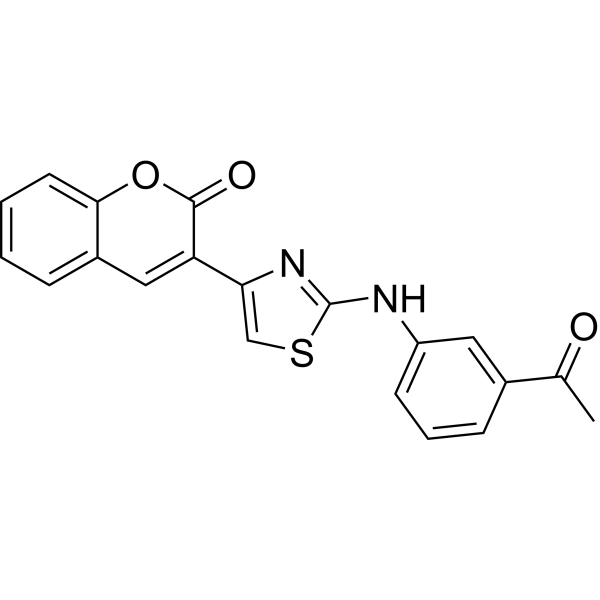
 0 ImagesIRBP (651-670) human, mouse is an epitope and uveitis inducer naturally processed from the conserved region of native IRBP. IRBP (651-670) human, mouse increases the levels of proinflammatory cytokines in ocular tissues (IL-1β, IL-6, TNFα, IL-17A and IL-17F). IRBP (651-670) human, mouse is a IRBP fragment conserved among human, mouse and bovine species. IRBP (651-670) human, mouse induces experimental autoimmune uveitis. IRBP (651-670) human, mouse is applicable to research related to experimental autoimmune uveitis.
-
Tinlarebant
 0 ImagesSynonyms: LBS-008; BPN-14967Tinlarebant (LBS-008) is an orally active non-retinoid RBP4 (retinol-binding protein 4) antagonist. Tinlarebant can be used for the research of the Stargardt disease.
-
RBP4 inhibitor 1
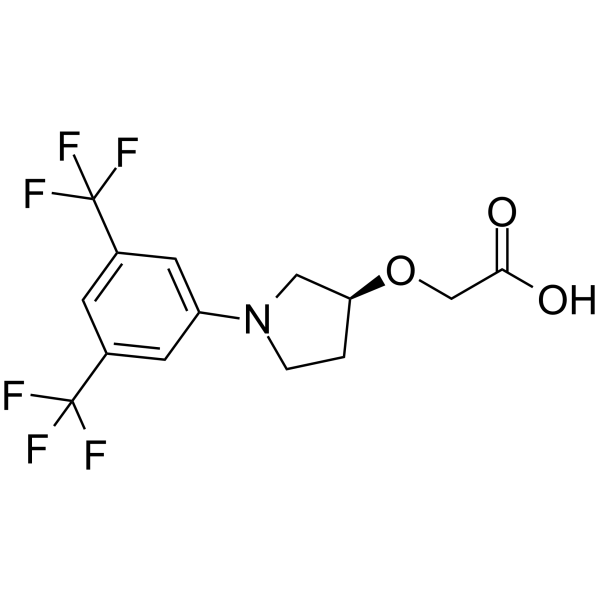 0 ImagesRBP4 inhibitor 1 (compound 43b) is a potent and orally active retinol-binding protein 4 (RBP4) inhibitor with IC50s of 28 nM and 110 nM for human and mouse RBP4. RBP4 inhibitor 1 has a potent and long-lasting blood RBP4-level-reducing effect in mice.
-
BPN-14136
 0 ImagesArt. -Nr.: HY-182385CAS. Nr.: 1628945-93-6BPN-14136 is an orally effective retinol-binding protein 4 (RBP4) inhibitor. BPN-14136 inhibits the binding of retinol to RBP4 with an IC50 of 12.8 nM. BPN-14136 inhibits retinol-dependent RBP4-transthyretin interaction (IC50 = 43.6 nM) and reduces circulating plasma RBP4 levels in vivo. BPN-14136 decreases the formation of cytotoxic bisretinoids in retinal pigment epithelial cells. BPN-14136 can be used for the research of atrophic age-related macular degeneration and Stargardt disease.
-
Anti-NGAL Antibody
 0 ImagesArt. -Nr.: HY-P992272
-
RBP4-IN-2
 0 ImagesArt. -Nr.: HY-185132CAS. Nr.: 3086854-73-8RBP4-IN-2 (Compound 14) is a RBP4 inhibitor. RBP4-IN-2 can reduce RBP4 in mouse plasma by more than 50%. RBP4-IN-2 can be used to study diseases where excessive lipofuscin accumulates in the retina.
-
ZINC00230567
 0 ImagesArt. -Nr.: HY-164959CAS. Nr.: 300816-12-0ZINC00230567 is an inhibitor for Lipocalin-2 (LCN2). ZINC00230567 reduces the colony formation and cell viability of cell SUM149, and exhibits anti-tumor efficacy.
-
Plafibride
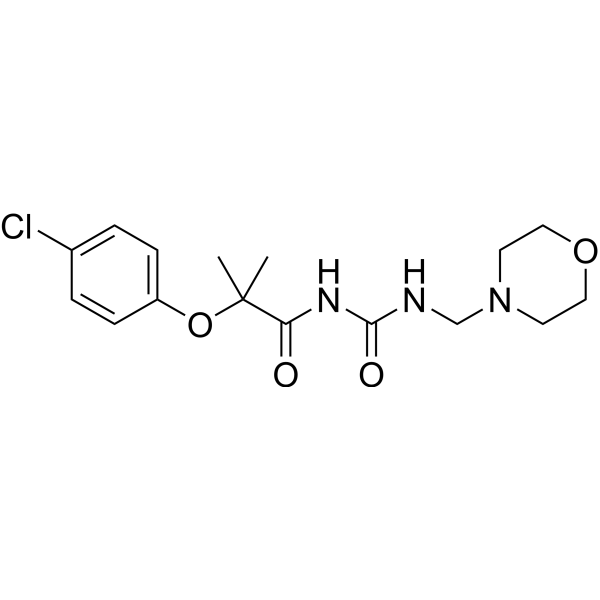 0 ImagesArt. -Nr.: HY-106580CAS. Nr.: 63394-05-8Synonyms: ITA 104Plafibride (ITA 104) is an orally active hypolipemic, platelet aggregation inhibitor.
-
Anti-Lipocalin-2 Antibody
 0 ImagesArt. -Nr.: HY-P992261
-
IRBP(651-670) human, mouse TFA
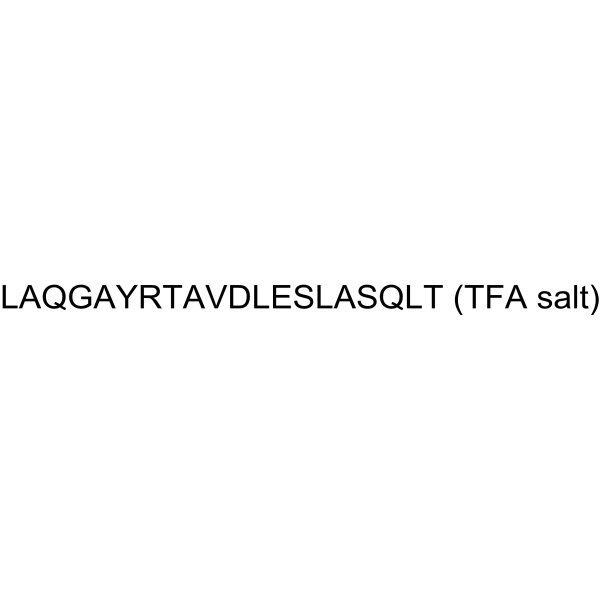 0 ImagesArt. -Nr.: HY-P1924AIRBP (651-670) human, mouse TFA is an epitope and uveitis inducer naturally processed from the conserved region of native IRBP. IRBP (651-670) human, mouse TFA increases the levels of proinflammatory cytokines in ocular tissues (IL-1β, IL-6, TNFα, IL-17A and IL-17F). IRBP (651-670) human, mouse TFA is a IRBP fragment conserved among human, mouse and bovine species. IRBP (651-670) human, mouse TFA induces experimental autoimmune uveitis. IRBP (651-670) human, mouse TFA is applicable to research related to experimental autoimmune uveitis.
-
Neutrophil Gelatinase Associated Lipocalin (NGAL), Human
 0 ImagesArt. -Nr.: HY-E70617Neutrophil Gelatinase Associated Lipocalin (NGAL), Human (EC 6.1.1.3) belongs to the lipocalin family and is primarily secreted by activated neutrophils. The connection of Neutrophil Gelatinase Associated Lipocalin (NGAL), Human to MMP-9 increases the activity of MMP-9 and protects against its degradation. Neutrophil Gelatinase Associated Lipocalin (NGAL), Human is known mainly as a biomarker of acute kidney injury and is released after tubular damage and during renal regeneration processes.
-
RBP4 ligand-1
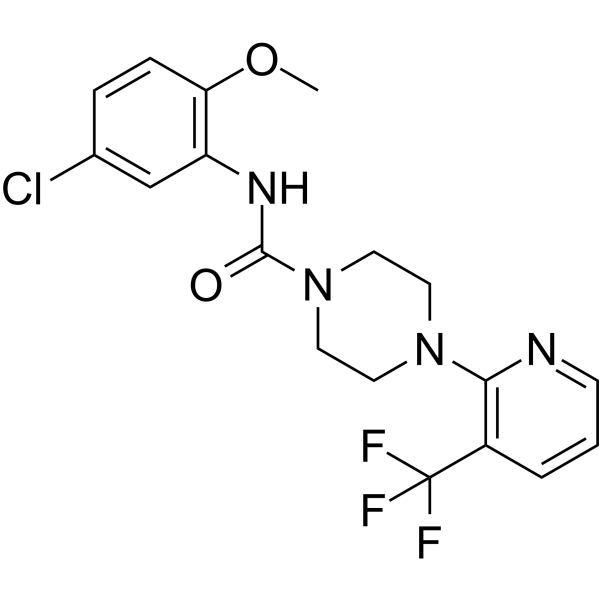 0 ImagesArt. -Nr.: HY-147366CAS. Nr.: 260553-24-0RBP4 ligand-1 is a non-retinoid ligands for (RBP4) retinol-binding protein 4. The hRBP4SPA IC50 and RBP4-TTR FRET IC50 values are 0.23±0.11 and 0.13±0.12 μM in the radioligand binding assay and FRET assay, respectively.
-
STG-001
 0 ImagesArt. -Nr.: HY-172232CAS. Nr.: 1911650-53-7STG-001 is a retinol binding protein 4 (RBP4) antagonist. STG-001 inhibits RBP4 to reduce the synthesis of retinal and diretinol, thereby preventing photoreceptor degeneration. STG-001 can be used in the study of sexually precocious nephropathy (STGD).
-
RBP4-IN-3
 0 ImagesArt. -Nr.: HY-185133CAS. Nr.: 3107328-23-1RBP4-IN-3 (Compound 38) is a retinol-binding protein 4 (RBP4) inhibitor. RBP4-IN-3 can be used in studies related to cardiovascular diseases and obesity.
-
Plafibride hydrochloride
 0 ImagesArt. -Nr.: HY-106580ACAS. Nr.: 65285-81-6Synonyms: ITA 104 hydrochloridePlafibride hydrochloride (ITA 104 hydrochloride) is an orally active hypolipemic, platelet aggregation inhibitor.
-
Arachidonoyl-1-thio-glycerol
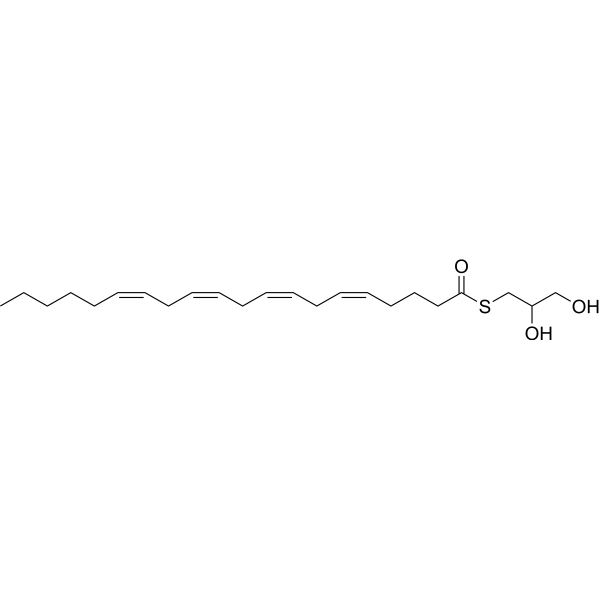 0 ImagesArt. -Nr.: HY-139394CAS. Nr.: 1309664-54-7Arachidonoyl-1-thio-glycerol (Compound 5) is an nonretinoid ligand lipid that can interact with cellular retinol binding protein 2 (CRBP2).
-
(S,R)-Bis(monomyristoylglycero)phosphate ammonium
 0 ImagesArt. -Nr.: HY-W339816CAS. Nr.: 325466-03-3(S,R)-Bis(monomyristoylglycero)phosphate ammonium actively contributes to cargo sorting by promoting the degradation and sorting of lipids, and it plays a critical role in the sorting of polyunsaturated fatty acids (PUFAs) within acidic organelles. This phospholipid features two phosphate-linked glycerol molecules arranged in a unique sn-1 glycerophospho-sn-1′ glycerol stereoconformation, with each glycerol molecule esterified to a myristic acid. Typically, it is found in the intraluminal vesicles (ILVs) of late endosomes and lysosomes.
- 1



